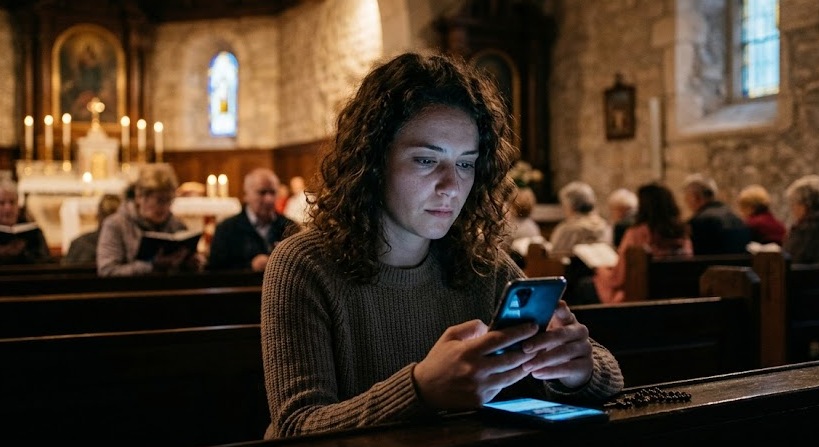
The Expansion of the Digital Desert
Is the Algorithmic Gospel replacing the living community? While our screens are filled with Bible quotes, our hearts are growing increasingly empty. We explore how digital presence has become a comfort that cannot embrace and a faith that no longer knows its neighbor face-to-face.
We are living in a historical paradox: we have never been more connected, yet we have never felt so lonely. The average internet user spends more than six hours a day online, yet research, like the landmark Harvard Study of Adult Development, consistently proves that only real, deep human relationships keep us healthy and happy. For a Christian, this is not just a sociological problem—it is a crisis at the very core of our faith.
Our faith is an incarnational one. God didn’t send a PDF with instructions, nor did He post a status update on social media; He became Flesh. Yet, in the world of the “Algorithmic Gospel,” we are slowly trading that Flesh for pixels.
Faith as a Performance and the Illusion of Fulfillment
From a psychological perspective, social media is explicitly designed to feed our need for validation. Every “like” on our post about Sunday Mass or a verse from Scripture releases dopamine, creating the illusion that we’ve done something great for the kingdom of God. But is that true witnessing, or just a performance?
The renowned sociologist Zygmunt Bauman warned us about “liquid modernity,” a state where genuine communities are replaced by networks. In a network, it’s easy to connect, but even easier to disconnect. In a real Christian community—the one sitting in the pews, smelling slightly of damp coat wool, with a neighbor singing loudly out of key—you can’t just hit unfollow. There, you are forced to love the person who gets on your nerves. That is where faith is truly refined, not in the sterile comment section where we curate only those who echo our own thoughts.
The Numbers Uncovering the Depth of the Crisis
To truly understand the scale of this phenomenon, we have to look past simple impressions and dive into hard data from journalistic and scientific research. Pastoral trend analyses across Europe and North America point to a dramatic shift: while physical attendance at Sunday services continues to drop, viewership of religious content, prayer apps, and online livestreams is hitting record highs.
A study by the Pew Research Center reveals that nearly a quarter of regular churchgoers have completely replaced or supplemented in-person services with digital streams. But the data reveals a darker side to this trend: more than half of those who consume their faith exclusively through a screen report a heavy sense of spiritual isolation.
Particularly fascinating is the boom in daily prayer and meditation apps, which are being downloaded by hundreds of millions of people. The software companies translating actual spiritual life into user retention metrics and daily “streaks” openly admit to using the exact same gamification tactics as gambling platforms or mainstream social media. In the background, faith subtly turns into a product optimized for user experience, and prayer becomes a habit built into an algorithm meant to hold your attention.
“Where Two or Three Are Gathered…”—But in Person
Jesus says, “For where two or three gather in my name, there am I with them” (Matthew 18:20). The question I have to ask myself as a researcher is straightforward: can that gathering really apply to a Zoom call or a Facebook group?
From a theological standpoint, sacramental presence demands physical proximity. You cannot receive Holy Communion through a screen, nor can the Anointing of the Sick be delivered with an emoji. The digital world offers information about God, but a real community offers the experience of God. The danger of digital religiosity is that it turns Christians into spectators rather than participants. We become consumers of spiritual content, much like binge-watching a series on Netflix, completely losing sight of the fact that faith is a journey walked with people, not a scroll through a newsfeed.
Loneliness in the Crowd and the Generational Divide
A study by the Barna Group brought a striking fact to light: young believers who are the most active on digital platforms often report the highest feelings of isolation from their local parish community. Nearly 60 percent of Gen Z individuals who identify as Christian admit it is easier for them to share a spiritual struggle or a prayer request with a stranger in the comments than in person with their own pastor or peers at church.
Why is this happening? Because digital presence offers breadth, but not depth. You can have 5,000 online friends, but who among them will show up at your doorstep when you fall ill?
In the Old Testament, we read: “It is not good for the man to be alone” (Genesis 2:18). God created us for tangible relationships—for a hand extended in peace, for a shared meal around a table. The digital world has convinced us that staying “in the loop” is the same as being present with someone. That is a lie sold by an algorithm that wants your attention, not your holiness.
Returning to an Authentic Encounter
As a journalist, I have no desire to demonize technology—it is a tool. But a tool must never become the temple. If our Christianity degrades into nothing more than a collection of pretty pictures and catchy quotes on a screen, we risk becoming “a resounding gong or a clanging cymbal” (1 Corinthians 13:1), just rendered in higher resolution.
It is time to ask ourselves: are we seeking comfort in the comments of strangers because we are afraid to show our true, imperfect faces to the people right next to us? Christianity isn’t lived in the cloud; it is lived on solid ground. We are called to step out of digital solitude and rediscover the beauty in the face of the person sitting right beside us. Because at the end of the day, God won’t ask us how many quotes we shared, but how many times we recognized Him in the stranger right in front of us—live, unfiltered, and without an algorithm.




Leave a Reply